Scriptural Symbolism: Two Worked Examples

The text of Scripture is laden with symbolism, so interpreting it in an informed manner is a big deal. Below I’ll provide a couple of worked examples of how that can be done, both of which are taken from the book of Revelation (which isn’t exactly shy of symbolism). How well these examples work will be for you to judge.
The Woman of Revelation 12
And a great sign appeared in heaven—a woman clothed with the sun, with the moon under her feet, and on her head a crown of twelve stars.
(Rev. 12.1)
The woman of Revelation 12 occupies a liminal position in redemption history, as we’d expect given that she gives birth to Israel’s Messiah. This is carefully reflected in the imagery associated with her.
The twelve stars in her crown go back to Joseph’s dream, where they depict Israel’s patriarchs (Gen. 37.9–10). The moon depicts Israel’s matriarchs (Gen. 37.10) and, by extension, Israel as a whole. And the woman is ‘clothed by the sun’ because the sun is rising behind her, depicting the dawn of the new covenant.
Considered in isolation these claims seem a bit sketchy. But it becomes clear that they’re more than mere guesses when we consider the network of symbols they create, which is what Scriptural typology is all about (James Jordan, Through New Eyes, somewhere near the start).
Just as each day in Genesis 1 moves from darkness to light, so too does history more broadly as it approaches the rise of the Sun/Son (Mal. 4.2) (James Jordan, Through New Eyes, a bit later); the moon and stars have an intrinsic connection in that they’re both rulers of the night (Psa. 136.8–9); in Revelation Jesus is associated with the sun (1.16, 19.12–17), which the clouds of demons seek to darken (9.2); and the moon makes an apt depiction of the old covenant because, in the context of the aforementioned movement from night to day, it reflects the light of Jesus the Son ahead of time (i.e., prior to the Son-rise), just as the ‘lesser light’ of John the Baptist did (John 1.6–9).
Also worthy of note are the events of the sixth seal, in which the sun turns black and the moon turns to blood (Joel 2.31, Rev. 6.12). In AD 70, Jesus came out in judgment against Jerusalem. Just as the Nile turned to blood in reflection of the Hebrew blood that Egypt had shed (Exod. 1), so in AD 70 the moon turned to blood in light of the blood that the new Egypt—old covenant Israel—had shed (Matt. 2.1ff., 23.29–39).
With that in mind, let’s consider a second worked example, which picks up on the connection between the woman’s crown and the stars.
The New Jerusalem’s Gemstones
The foundations of the [new Jerusalem’s] wall were adorned with every kind of jewel. The first was jasper, the second sapphire, the third agate, the fourth emerald, the fifth onyx, the sixth carnelian, the seventh chrysolite, the eighth beryl, the ninth topaz, the tenth chrysoprase, the eleventh jacinth, the twelfth amethyst.
(Rev. 21.19–20)
The new Jerusalem that descends from heaven in Revelation 21 is adorned with twelve gemstones. These are similar to the gemstones in the high priest’s breastplate (Exod. 28.17–21), but aren’t identical to them. They’re the gemstones that were associated with the constellations of the zodiac in our earliest records (which come from Egypt),1 but they’re listed in exactly the opposite order to their zodiacal order (which isn’t a coincidence).
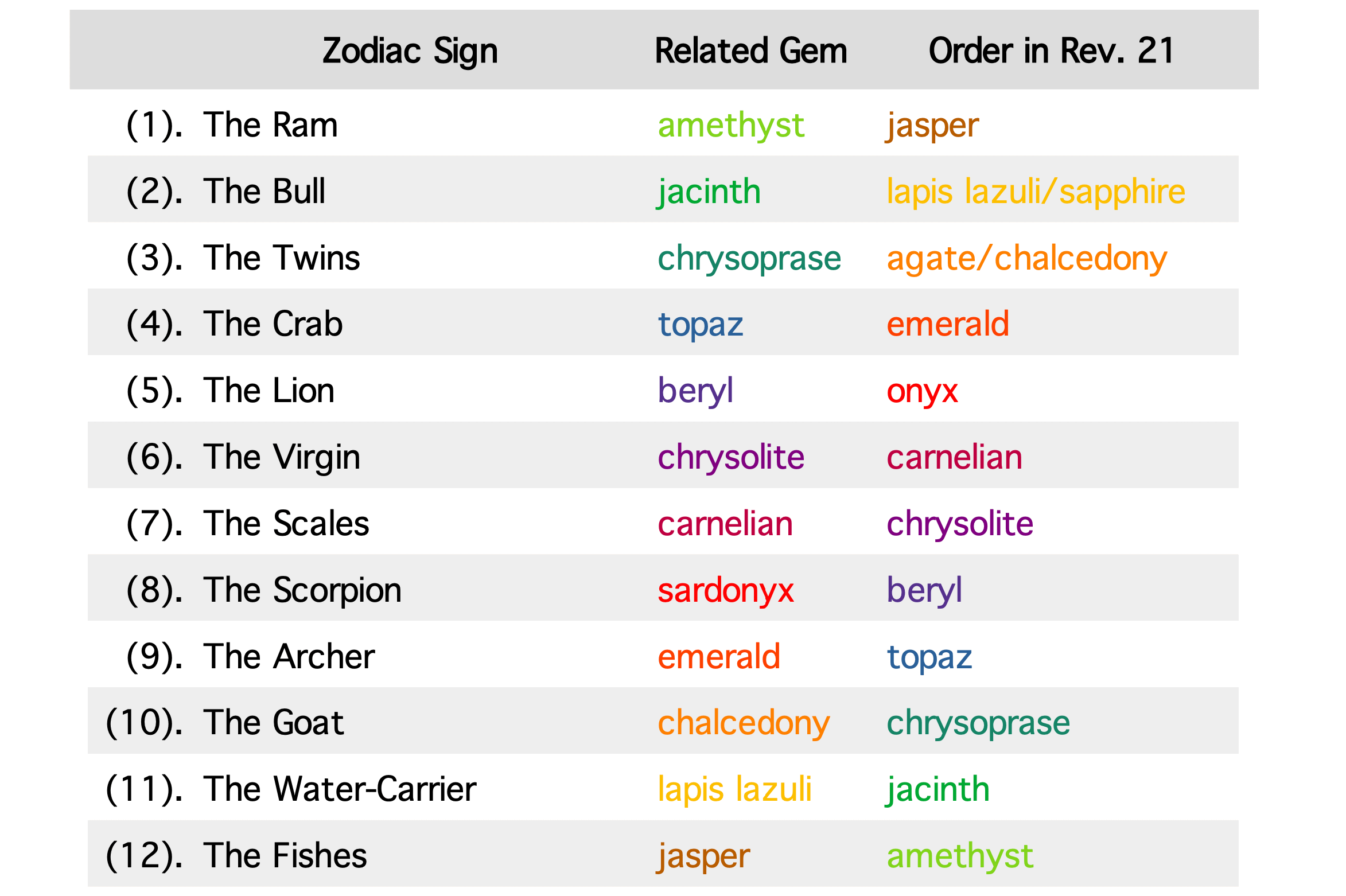
That John connects these twelve gemstones with the zodiac’s constellations shouldn’t surprise us. The number twelve has a natural connection with the zodiac given the twelve months of the calendar; Josephus connects the gemstones on the high priest’s breastplate with the zodiac (Jos. Ant. III.7.7); and John depicts the patriarchs as jewel-like stars/constellations in Revelation 12.1 (where they crown the woman we considered above).
This connection between the foundations of the new Jerusalem and heaven’s constellations is significant. Canaan was a land where Israel could flourish because they could extract bronze from the earth (Deut. 8.9), but, when Israel was cursed, the world turned upside down: the heavens rather than the earth became like bronze, and rained down dust (Deut. 28.23–24). Here in the new Jerusalem, the world has been turned the right way up again through the witness of a new kind of Israel, i.e., the twelve apostles. (‘These men…have turned the world upside down,…saying there is another king, Jesus!’: Acts 17.6.) While Satan casts stars down to the earth, with devastating results (12.4ff.), the new Jerusalem plants stars in the earth. The earth is made to mirror the glory of the heavens above it.
Of particular significance is the fact that John reverses the order of the zodiac’s gemstones. The zodiac tracks the passage of time (by reference to the sun, moon, and stars), and so its reversal depicts the reversal of time, which is precisely what the climax of John’s visions describes, i.e., the reversal of creation’s curse. Creation is rewound to a pre-fall Edenic state.
The same idea underlies the culmination of John’s Gospel. By way of background, consider what we encounter as we move through the text of Genesis 2–3:
a barren garden

   the creation of Eve (from Adam’s side)

      a thorn-cursed creation

         a fiery sword-bearer (blocking the way to the tree of life)
In John 18–19, we encounter counterparts to these events, but in reverse order, since by means of them Jesus undoes Adam’s fall.
         First of all Jesus approaches the garden’s guards, who are equipped with
         torches and weapons, and fall backwards as Jesus announces his identity.
         The way to the tree of life is about to be reopened.

      Next Jesus is brought before Pilate’s judgment seat, where he’s crowned with
      thorns, depicting the curse that he’s about to bear.

   Afterwards a spear is thrust into Jesus’ side, from which living water flows
   forth.  (The name ‘Eve’ means ‘life’.)

And, finally, just as Eden is ‘planted’ in a land in which no-one has previously
laboured, so Jesus’ body/seed is planted in a tomb in a garden, in which no-one
has previously lain (Gen. 2.5–8, John 19.41).  Like Adam, then, Jesus returns to
the ground.
Hence, just as John’s Gospel describes the world being rewound to a pre-fall state, so too do John’s visions. In some senses, that might seem inappropriate because rewinding time takes us back to a world prior to Jesus’ redemptive work. But this isn’t a problem for John because, in the context of his visions, the effects of the cross and/or election transcend time. The name of every believer has been ‘written in the Lamb’s book of life since the commencement of the world’ (or possibly even, depending on how you translate the relevant text, written in the book of ‘the Lamb who has been slain since the commencement of the world’) (Rev. 13.8).2
Conclusions
The interpretation of a given Scriptural symbol can’t be evaluated in isolation, nor can it be evaluated in a hurry. Scriptural symbology is all about whole networks of symbols that work together and inform one another, and so evaluating them takes time and careful thought. It also requires flexibility. We need to be able to abandon an interpretation if it’s not working.
The details can be found in the second volume of Kircher’s Oedipi Aegyptiaci, pp. 176ff..
One can argue about the merits of these translations all day. Ultimately, the phrase ‘since the commencement of the world’ can be taken to modify either ‘slain’ or ‘written’, and Revelation 13.8 needn’t be taken to say the same thing as 17.8 (which clearly refers to a book that’s been ‘written since the commencement of the world’). John’s statement is therefore ambiguous, which I take to be deliberate.
The gemstones being reversed is really interesting! Thanks for that detail James.
Re “the world being rewound to a pre-fall state”. Do you remember that a while ago I asked you whether you’d ever come across the idea that the Bible is a grand chiasm? This post of yours is outlining some of the lineaments of that chiasm.
PS If you use this idea, I’d appreciate it if you give me credit. 😉