Interpretative Notes on Revelation 12


It’s sometimes hard to know where to start when it comes to the book of Revelation. Let’s dive in at chapter 12 and see how we fare.
The Main Events
First the chapter’s main events. Revelation 12.1–2 opens with a sign—a woman clothed with the sun who’s about to deliver a child. Then in 12.3–4 we have another sign—the enemy of the woman, a dragon with seven heads and ten horns, who sweeps a third of the stars of heaven down to the earth and seeks to devour the woman’s child.
Happily, the woman manages to safely deliver her child (who’s ‘caught up to God and his throne’), at which point the woman flees into the wilderness, where she’s preserved for 1,260 days (Rev. 12.5–6).
Next, war breaks out in the heavenly realms. The dragon is cast down to the earth, together with his angels; meanwhile, a song breaks out in the heavenly realms (Rev. 12.7–12). Once cast down, the dragon turns his attention to the woman herself, but she escapes and hides out in the wilderness (12.13–16).
Finally, its plans thwarted, the dragon heads off to wage war against ‘the rest of the woman’s seed’ (Rev. 12.17).
The Sequence of Events
The first thing we need to note about these events is their inner logic. Each follows on from what precedes it, without any obvious gaps/discontinuities. The dragon casts a third of the stars down to the earth, which is what leads/enables it to pursue the woman’s child; next the woman’s child ascends to God’s heavenly throne, which is what leads to the expulsion of the dragon; and finally the dragon turn its attention to the woman (because it has been expelled from heaven). As far as possible, then, we should interpret these events in terms of a continuous sequence of events.
With that in mind, let’s identify some of the main players. The dragon is clearly Satan (Rev. 12.9), who stands behind the earth’s powers and principalities and turns them against the woman and her child.
Equally clearly, the woman’s child is Christ, who’s destined to rule the nations with a rod of iron (12.5).
As for the woman, she’s framed against the backdrop of the sun and moon and twelve stars (Rev. 12.1), which is reminiscent of Joseph’s dream in Genesis 37 (where Joseph’s parents are depicted as the sun and the moon, and his brothers as stars: Gen. 37). So the woman is clearly connected with Israel in some way (hence she gives birth to Christ). I take her to reflect the faithful remnant of Israel. (In Revelation 17 we meet her unfaithful counterpart, who’s tainted by the red hue of the dragon: 12.3, 17.3–4.)
The Nature of the Beast
But what about the dragon, with its seven heads and ten horns? The answer will take us a while to spell out, but we’ll get there.
The notion of a ten-horned monster is rooted in Daniel 7, where Israel’s overlords are depicted as a sequence of four beasts.
The first is Babylon, the second Medo-Persia, and the third Greece. That much is clear. Indeed, all of these kingdoms are explicitly named by Daniel (Dan. 1.1, 5.28, 6.8, 10.20, 11.2).
The fourth beast isn’t so easy to identify. It clearly embodies elements of Rome’s might, but it’s not identical with Rome (on which see below). Its key distinctive is its hatred of heaven and God’s people (Dan. 7.23ff.). The fourth beast doesn’t ultimately, therefore, seem to be any particular earthly empire; rather, it’s what the NT variously refers to as ‘the world’ or ‘the kingdom of darkness/Satan’. (Our battle isn’t against flesh and blood: Eph. 6.12.)1 Daniel’s fourth beast is thus a very different kind of animal to its forerunners (as Daniel repeatedly states). It’s a spiritual rather than geo-political entity. That’s why: a] it’s said to be so ‘different’ from the world’s previous kingdoms (Dan. 7.7, 23) (which Rome wasn’t in any significant way), b] it’s left unnamed in Daniel’s visions,2 c] it’s depicted in such unnatural terms (with iron teeth and bronze claws) and isn’t likened to any earthly creature (Dan. 7.7, 19), d] it’s said to rule primarily by fear (Dan. 7.7, 19, Heb. 2.15), and e] its fall marks a watershed moment in the saints’ fortunes: their persecution comes to an end and their enemies receieve their comeuppance (which can be said of 70 AD only in a very limited/qualified sense) (Dan. 7.21–22).3
The rise of the fourth beast must, therefore, coincide with the time of the New Testament—which is as we would expect. The life, death, and resurrection of Christ ushered in a new era in world history. Christ’s incarnation was greeted by a surge of demonic activity in Israel, and, with his ascension, the time came for ‘the prince of the present age’ to be cast down (John 12). World history would no longer be about Israel-versus-the-nations or about geo-politics more generally (although these things obviously affect its course). It would be about two coterminous kingdoms—the kingdoms of God and Satan, of light and darkness—, and will end in the triumph of the former over the latter (Matt. 13, Acts 26.18, Col. 1.13).
Note: Given the above view of the fourth beast, we can explain the different periods of time associated with the woman and the beast. The woman is associated with a period of 1,260 days—i.e., with periods of time defined by reference to the Sun/Son—because she’s part of the kingdom of light. Meanwhile, the beast is associated with a period of 42 months—i.e., periods of time defined by reference to the moon—because she’s associated with the night and with darkness (Rev. 12.6, 13.5). (More on these lengths of time later.)
All well and good, one might say. But what about Revelation’s beast? (So far we’ve only discussed Daniel’s.)
Well, Revelation’s beast is ‘a beast of beasts’. It combines elements of all four of Daniel’s beasts (a lion’s mouth, a bear’s feet, a leopard-like appearance, and ten horns: Rev. 13.1–2), with a particular focus on the fourth and final beast. We can thus fill out its details as follows.4
The first three heads are thus Babylon, Medo-Persia, and Greece.
The fourth head depicts the Jews who ruled Judah in the aftermath of Antiochus’s fall, and whose rise is implied by ‘the end’ of Greece’s period of dominion over Judah (Dan. 8.20–23).
The fifth head depicts the rise of Herod, whose attempt to devour Jesus is precisely what’s depicted in Rev. 12.4, and his dynasty. As such, it depicts the rise of a fundamentally new regime in Judah—one headed up by a non-Jew and hostile to the Jewish religion.
The sixth head depicts the present kingdom of darkness, i.e., the kingdom which now ‘is’ (Rev. 17.10) and is currently at war with the Church (Dan. 7.19–21, 1 John 5.19).5
And the seventh head depicts the final stage of the beast’s existence, when ten kings will rise to power (for an hour) (Rev. 17.12).6
An Excursus on the Fourth Head
Most Christians are (understandably) unfamiliar with inter-testamental history, but it’s an integral part of Daniel’s visions, and any continuous description of the events between the rise of Daniel’s first beast and Christ’s incarnation has to cover it. Before we continue any further, then, a word or two about the so-called ‘gap between the testaments’ is in order.
In the aftermath of Medo-Persia’s fall, Alexander the Great arose (333–323 BC). Alexander’s rise to power was meteoric (to put it mildly). But as quickly as Alexander rose, he fell, and his kingdom splintered into four sub-kingdoms (Dan. 8.8).
From one of those four sub-kingdoms, Antiochus Epiphanes arose.
Antiochus wrought havoc in Judah until Judas Maccabees overthrew him, which marked a significant event in Israel’s history. Indeed, in Daniel’s visions, the rise of Antiochus coincides with ‘the latter end’ of Greece’s period of dominion over Judah (Dan. 8.22–25), and so his fall marks the dawn of a new era.7
On the back of Judas Maccabees’ success, Jonathan Apphus (152–143 BC) established Judah as a semi-independent state, which paved the way for the rise/formation of the Hasmonean Dynasty (143–37 BC). (The Hasmoneans held the office of both king and high-priest.) The Judaeans thus enjoyed a period of respite from foreign oppression. But with the rise of Herod (a non-Jew) all that began to change.
In 40 BC the Roman Senate declared Herod ‘King of the Jews’, which was decidedly bad news for Judah. First Herod convinced Mark Antony to execute the last Hasmonean king (Antigonus II) (37 BC); then he drowned Judah’s high-priest (Aristobulus III) (35 BC); and finally he disposed of a former Hasmonean king known (Hyrcanus II) (30 BC). (He also executed his wife and her two sons for good measure.) What we read about Herod in the New Testament is, therefore, consistent with what we know about him from other sources.
The Dragon
Revelation’s beast is effectively, therefore, a composite of Daniel’s beasts. Fine.
But we still need to address the issue of Revelation 12’s dragon. Why does Revelation 12 describe a seven-headed and ten-horned dragon rather than a seven-headed and ten-horned beast?
The answer is because it’s a picture of seven particular kingdoms insofar as they’re energised and directed by Satan (and by extension hostile to God’s people). Daniel’s beasts are to some extent neutral entities. What matters is who rides them. In Cyrus’s day the Medo-Persian bear returned the Jews from exile and helped them rebuild the temple, but in Haman’s day the bear turned nasty (until Esther tamed it). Similarly, Revelation’s beast has an element of neutrality. It’s not necessarily or ceaselessly hostile to God’s people. But in Revelation 12, energised by Satan, it turns nasty, which is the sense in which John’s vision is a ‘revelation’. It reveals the forces at work behind the world’s power structures. The dragon and the beast become one.
Interpretation
With the above backdrop in mind, we can summarise the events depicted in Revelation 12’s vision as follows.
In 12.1–2, the time for the Messiah begins to draw nigh, which Satan becomes aware of. Satan thus starts to incite the seven-headed beast to do his work. Specifically, Satan incites Herod (the fifth head) to establish an iron grip on Judah, which he accomplishes by the deposition of two Hasmonean kings-and-priests and a high-priest (Antigonus II, Aristobulus III, and Hyrcanus II) (12.3). Hence, just as Antiochus deposes Judah’s priests and rulers in Daniel 8 and thereby ‘casts the stars of heaven down to the earth’ (Dan. 8.10–11), so too does Herod. And, significantly, insofar as Herod executes three Hasmonean lights, he deposes ‘a third’ of the fourth head’s ten kingly/priestly stars (12.4) (and becomes an eleventh).8
As such, Herod’s career constitutes a remarkable foreshadow of that of Satan’s final king, who is said to subdue three of the beast’s ten horns (and to become an eleventh) (Dan. 7.24).
In Revelation 12.4–5, the woman’s (Israel’s) child is born, which is ultimately what Satan is after. Hence, in the person of Herod, Satan seeks to devour the child as soon as it’s born.
Happily, however, Satan’s attempts to thwart God’s plans fail. The child is not brought down to the pit by Satan, but is caught up to God’s heavenly throne (12.5), and the woman is protected by God in the wilderness for a period of 1,260 days (on which see below).
Revelation 12.7–16 then fills out the details of what’s been summarised in 12.5–6. In the aftermath of Christ’s ascension, a war breaks out in the heavens (12.7), which is no brief skirmish. It takes place over a protracted period of time (possibly one of the ‘times’ of the ‘time, times, and half a time’ of Rev. 12.14). Michael and his angels fight against the dragon, and the dragon and his angels fight back (12.7).9
In the end, Satan is defeated and cast down to the earth. Just as he dethrones rulers via the career of Herod, so he himself is now dethroned (Rev. 12.8–9). Ironically, the basis on which Satan is overcome is precisely the lack of basis he has for his accusations. Satan cannot bring a valid accusation against those who have died in Christ and been cleansed in the blood of the Lamb (12.10–12). And so he instead turns his attention to the woman on the earth (i.e., to the early Jewish church), though again to no avail. The woman is enabled to hide away from Satan’s attacks for ‘a time, times, and half a time’ (12.13–16).
Chronology
We thus come to the issue of chronology. Two different periods of time are associated with the woman in Revelation 12—first 1,260 days and second ‘a time, times, and half a time’ (Rev. 12.13–16). Why?
Part of the answer could be that the 1,260 days aren’t meant to be taken literally. Schematically, they consist of a single period of time followed by a longer period of time (‘times’) and a shorter period of time (‘half a time’). We might, therefore, be intended to see the expulsion of the dragon as an event which takes place in the final ‘half a time’ of Revelation 12’s events (since the dragon’s time is said to be ‘short’: Rev. 12.12).
Still, why 1,260 days rather than, say, 100 days or 1,000 days? The answer concerns the nature of Daniel’s ‘70 weeks’.
Daniel portrays the future of God’s people and holy city in terms of a seventy-week period of time. These weeks culminate in a sequence of five specific events:
After the first 69 weeks, the Messiah is ‘cut off’ and left without a kingdom (Dan. 9.26a).
Some time later, the people of ‘a prince who is to come’ destroy Jerusalem and its sanctuary with a flood, which plunges Jerusalem into a period of ‘desolation’ (Dan. 9.26b).
A week-long covenant is established (9.27).
Midway through it the covenant’s instigator puts an end to Temple sacrifices, presumably by means of the Temple’s destruction (in which sense 9.27 recapitulates 9.26’s events, just as Rev. 12.7–17 recapitulates 12.5–6’s).10
Desolation ensues (9.27).
If the above summary of Daniel’s weeks is approximately correct, then Daniel’s 70th week consists of two halves: the first half lasts for roughly forty years, since it runs from the time of the Messiah to the fall of the Temple, and the second half runs from the fall of the Temple to the fulfilment of Daniel’s prophecy, which I take to be the end of the present age.11 The events of Revelation 12 can thus be chronologised as follows:
in 30 AD Christ ascends into the heavenly realms;
in the aftermath of his ascension, war breaks out, which is why Jesus can say ‘Now is the time for the prince of this world to be cast down’ in 30 AD (John 12); and
in 70 AD Satan abandons his pursuit of the woman (the early Jewish church) and instead turns his attention to ‘the rest of the woman’s seed’ (the Church) (Rev. 12.17), per the timeline below. (For convenience, we’ll call the two halves of Daniel’s 70th week ‘Week 70a’ and ‘Week 70b’.)

The same equation between the two halves of Daniel’s 70th week and Revelation’s visions is reflected elsewhere in Scripture. For instance, compare the events of Luke 21 with those of Revelation 5–11. In Luke 21, we have the events shown below.
(30–70 AD): persecution, wars, famines, signs in the heavens (vv. 8–19);
(70 AD): Jerusalem’s destruction (vv. 20–24);
(70 AD onwards): Jerusalem exiled among the nations and Jerusalem trampled underfoot until the times of the Gentiles are fulfilled (v. 24);
(end of the present age): convulsion of the heavens as the Son of Man returns (vv. 25–29).
Revelation 5–11 describes these same events, set against the backdrop of Daniel’s 70th Week.
Week 70a
persecution, wars, famines, signs in the heavens, the judgment of Jerusalem (i.e., the six seals) (Rev. 6)
the preservation of 144,000 early Jewish believers (Rev. 7a) = the preservation of the woman for 1,260 days (Rev. 12b)
Week 70b
demonically enacted judgments against the world (Rev. 8–9)
Christ unites Jew and Gentile (Rev. 10)
the holy city is trampled underfoot by the nations for 42 months (Rev. 11).12
In other words, the 30–70 AD events of Luke 21 are set against the backdrop of half a week in Revelation 6–7 and 12, and the post 70 AD onwards events of Luke 21 are set against the backdrop of another half a week in Revelation 11.
Apparently, then, as Daniel’s weeks unfold, time slows down (Rev. 10.6). The first half of the 70th week lasts 40 years, and the second half is still in progress. That might seem an odd way to divide a week into two ‘halves’, but its oddity has a purpose, since the first 40 years of the Church’s existence echo the first 40 of Israel’s, viz. the 40 years in the wilderness.
Just as Pharaoh seeks to drown Moses in the Nile, so the dragon seeks to eliminate its rival (Christ) while he is still a child.
Just as Moses is preserved and exalted to a position of authority, so too is Christ.13
Just as Moses’s people flee into the wilderness with Pharaoh the dragon in pursuit, so too do Christ’s.
And just as Israel are sustained in the wilderness, so too is the woman, who, like Israel, is borne away on eagle’s wings.
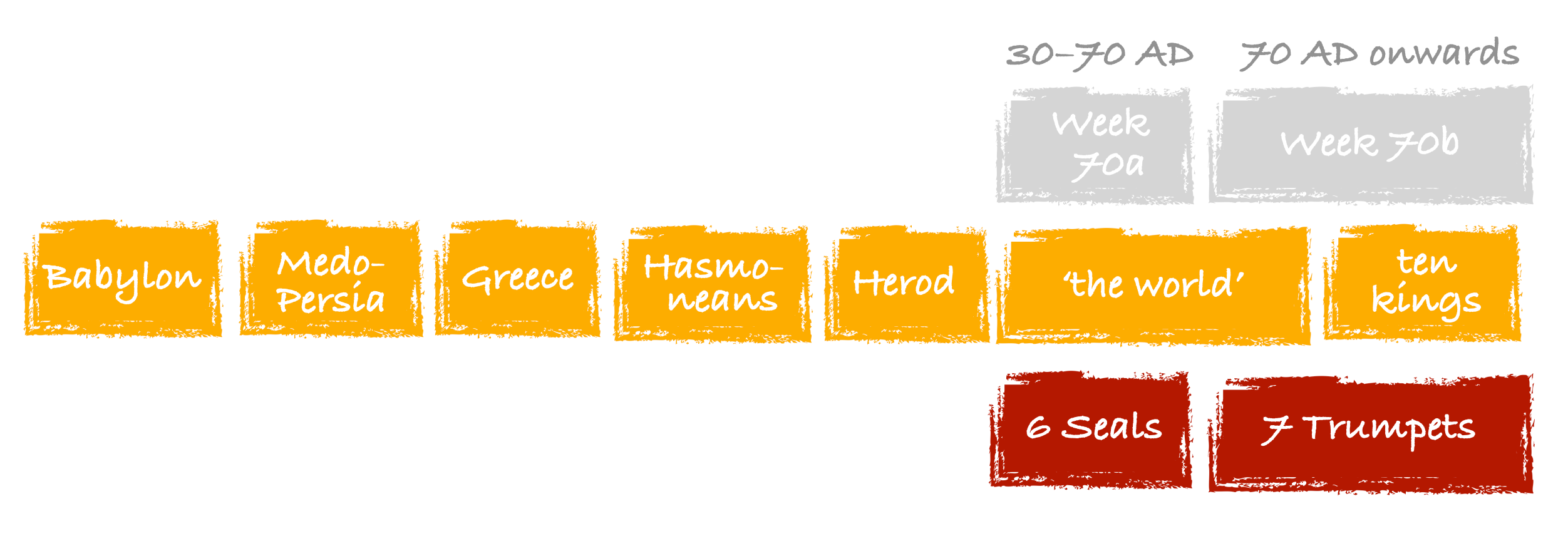
Given the above backdrop, we could reasonably expect the second half of the 70th week to echo Israel’s entrance into the promised land. And it does. For instance, we have a hostile city, two witnesses sent into it, an eerie silence followed by seven trumpet blasts (Rev. 8.1), the aforementioned city flattened as God’s Messiah starts to take possession of the nations (Rev. 11.15, Psa. 2), etc.
Conclusion
Of course much more needs to be said about all these things, but the thrust of the interpretation outlined above is (hopefully) clear, and not without merit, not least because it doesn’t require the insertion of gaps/discontinuities in Revelation 12’s vision or depend on a particular date of authorship for the book of Revelation.
Hence, in the book of Revelation, the Church is not said to be persecuted by the Jews or Romans per se, but by ‘the synagogue of Satan’ and ‘the dragon’ (Rev. 2.24, 12.3, 17).
Certain variations on the Roman hypothesis can avoid some of these objections.
The same point can be put in terms of the presence of God’s people. Scripture is not interested in history or geo-politics per se; its interest is the purposes of God. As such, the history of a nation like Babylon is largely irrelevant to Scripture. It only becomes relevant in 587 BC when Babylon conquers Judah and hence becomes the residence/overlord of God’s people. To some extent, then, Daniel’s beasts are defined by the presence of saints in their midst, which is why Daniel’s fourth beast encompasses the whole world. God’s people are now scattered throughout every tribe, tongue, and nation, and so the beast stands for the world as a whole.
Some commentators have sought to identify the beast’s seven heads with the various heads mentioned in Daniel 7: the lion (presumably) has one head, the leopard four, etc. But while such an approach is possible, it doesn’t strike me as necessary. Revelation’s beast isn’t an amalgamation of ‘heads’ per se; rather, it has the mouth of a lion, the feet of a bear, and so on.
Hence, at the time of John’s vision, the beast’s first five heads have fallen (Babylon, Medo-Persia, Greece, the Hasmoneans, and Herod are no more), the sixth Satanic kingdom is active, and the seventh kingdom is still to come (Rev. 17.10). Note: Revelation 13’s depiction of the beast is a carefully nuanced one. What is given authority to conquer the saints is not the beast per se (i.e., its worldwide presence throughout the present age), but its final horn (which is described in exactly the same terms as Daniel’s: Dan. 7.20–21). It thus depicts the anti-Christ and by extension other anti-Christs. The beast does not continually, therefore, overcome the saints; rather, certain anti-Christs arise from it who do so.
The ten horns are not distributed among the seven heads—say, a couple of the first head, one on the second, etc. Rather, the ten horns belong specifically to the seventh head. Note: To interpret the beast’s ten horns as a sequence of kings is awkward since a beast’s ‘horns’ depict co-regents in Daniel’s visions: the two horns of chapter 8’s ram are the contemporaneous kingships of the Medes and the Persians; the goat’s single horn is replaced by four horns, which are contemporaneous kingdoms (viz. the kingdoms of the Antigonids, Lysimachids, Seleucids, and Ptolemies); and the beast’s ten horns are said to receive power ‘for one hour’ (Rev. 17.12), given which they seem to receive power as a confederacy; indeed, that is how the beast’s eleventh horn is able to dethrone three of its predecessors (Dan. 7.8), which wouldn’t be possible unless they were roughly contemporary.
Daniel 8.14’s 2,300 days came to an end on the Day of Nicanor in 160 BC when Nicanor was slain by Judas Maccabees’, who fell in battle shortly afterwards.
The full list of kings/high-priests is as follows: [1] Jonathan Apphus (152–143 BC). [2] Simon Thassi (143–134 BC). [3] John Hyrcanus I (134–104 BC). [4] Aristobulus I (104–103 BC). [5] Alexander Jannaeus (103–76 BC). [6]. Queen Salome Alexandra (76–67 BC). [7] Hyrcanus II (67–40 BC) (executed), whose reign includes [8] Aristobulus II’s (Hyrcanus II’s brother) (66–63 BC). [9] Antigonus II Mattathias (Aristobulus II’s son) (40–37 BC) (executed). [10] Aristobulus III (high-priest in 36–35 BC) (executed). These details seem to be non-controversial. For instance, cp. wiki.
The protracted nature of Satan’s defeat is evident in the Gospels and epistles. Jesus sees Satan fall from heaven midway through his earthly ministry (Luke 10.18), and yet what Jesus sees is for the most part a premonition of future events, since shortly before his death he announces, ‘Now will the ruler of this world be cast out!’ (John 12.31). And Romans 16 describes the defeat of Satan as a yet future event (Rom. 16.20).
Elsewhere in Daniel, ungodly kings put an end to sacrifice (Dan. 8.11, 11.31). It therefore seems strained to interpret Daniel 9’s reference to the cessation of sacrifice as a reference to the work of Christ.
I don’t personally see how one can take Daniel’s 70 weeks to be fulfilled by the events of 70 AD, since these events are at odds with the whole tenor of Daniel’s prophecy (or, more accurately, Gabriel’s prophecy). Consider its context. Judah lies desolate, and Judah’s temple lies in ruins. Against that backdrop, Daniel pleads with God for the restoration of Jerusalem, and God answers Daniel’s prayer by means of a prophecy which (ostensibly) grants Daniel his request. It hardly, therefore, seems plausible to take that prophecy—spoken forth by the angel Gabriel—to culminate not in the expected restoration of Daniel’s people and holy city, but in the slaughter of Daniel’s people and the desolation of Jerusalem. True, prophecies aren’t always fulfilled in the way we might expect them to be, but the idea is still difficult to swallow, especially when Romans 9 extends a similar promise of restoration to the Jewish people (i.e., to Paul’s kinsmen). The same point can be put in more conceptual/theological terms. Daniel’s fundamental concern in chapter 9 is God’s glory: God has tied his reputation to Jerusalem, and, since Jerusalem lies in ruins, so too does God’s glory (for all the nations to see) (Dan. 9.16, etc.). What, then, is God’s response to Daniel’s prayer? To decree a sequence of events at the culmination of which Jerusalem will once again lie desolated and disgraced? To appreciate how problematic such a notion is, consider Herman Bavinck’s argument for the physical restoration of the present world. God’s honour, Bavinck says, is maintained by the way in which he redeems and restores precisely what sin corrupted—the same humanity, the same world, the same heaven, and the same earth. Bavinck’s argument strikes me as persuasive. It would not do for God to ‘restore’ the heavens and earth by means of, say, the population of a new planet with angelic creatures, since Satan would then have had the final say over the world’s destiny, and Christ would not have ‘undone’ Satan’s works (1 John 3.8). By the same token, it will not do for God to ‘restore’ Daniel’s people and holy city via the election of a people who are not Daniel’s people and a city which is not Jerusalem. In response, one could say Daniel’s people and city will be restored in the fulness of time, but one could still not say they were restored in 70 AD.
Note how the seven trumpets open with Egyptian-plague-like judgments against the world and the fall of a fiery mountain into the sea, which depicts the final fall of the old covenant order. Sinai sinks in Gentile waters (Rev. 8.8).
The parallel between Moses’s and Christ’s exaltation explains an otherwise rather odd feature of Revelation 12’s vision, viz. its omission of the cross in its depiction of Christ’s ministry (Rev. 12.5).
James,
I’m just making sure I’m reading this accurately. Regarding your interpretation of the 70th week, this is a definite departure from your previous work. If I recall, you saw the 70th week as entirely future and even wrote that you thought there would be a rebuilt temple with actual sacrifices. Here I read you as saying the first half of the week occurred in 70 AD. Is that correct?
Thanks,
John
Your observations regarding the restoration of Jerusalem in footnote 10 would seem to lean us towards a premillenial take on ch. 20?